Rådsmedlem Niels Hahn undersøger i et nyt konceptnotat, hvordan et grundlæggende princip i amerikansk sikkerhedsstrategi – at forhindre integrationen af Europa og Asien – kan bidrage til at forklare en række af nutidens krige og konflikter. Udgangspunktet er USA's nationale sikkerhedsstrategi fra 1988, hvor Reagan-administrationen beskrev det som en af USA's »mest grundlæggende nationale sikkerhedsinteresser« at forhindre, at en fjendtlig stat eller gruppe af stater dominerer den eurasiske landmasse.
Notatet udspringer af Niels Hahns forskning i USA's interventionsstrategier, med særligt fokus på brugen af mujahedin og jihadister. Ifølge Niels Hahn er der tegn på, at Türkiye og Saudi-Arabien er ved at nedtrappe relationerne til salafistiske og wahhabistiske miljøer og i stedet bevæger sig mod integration mellem Europa og Asien. Det indebærer et delvist brud med USA, som kan føre til destabilisering af de to lande – og det ser han som en af hovedårsagerne til, at Mecca Joint Defence Agreement mellem Türkiye, Saudi-Arabien og Pakistan er ved at blive etableret.
Omtalt i Milliyet
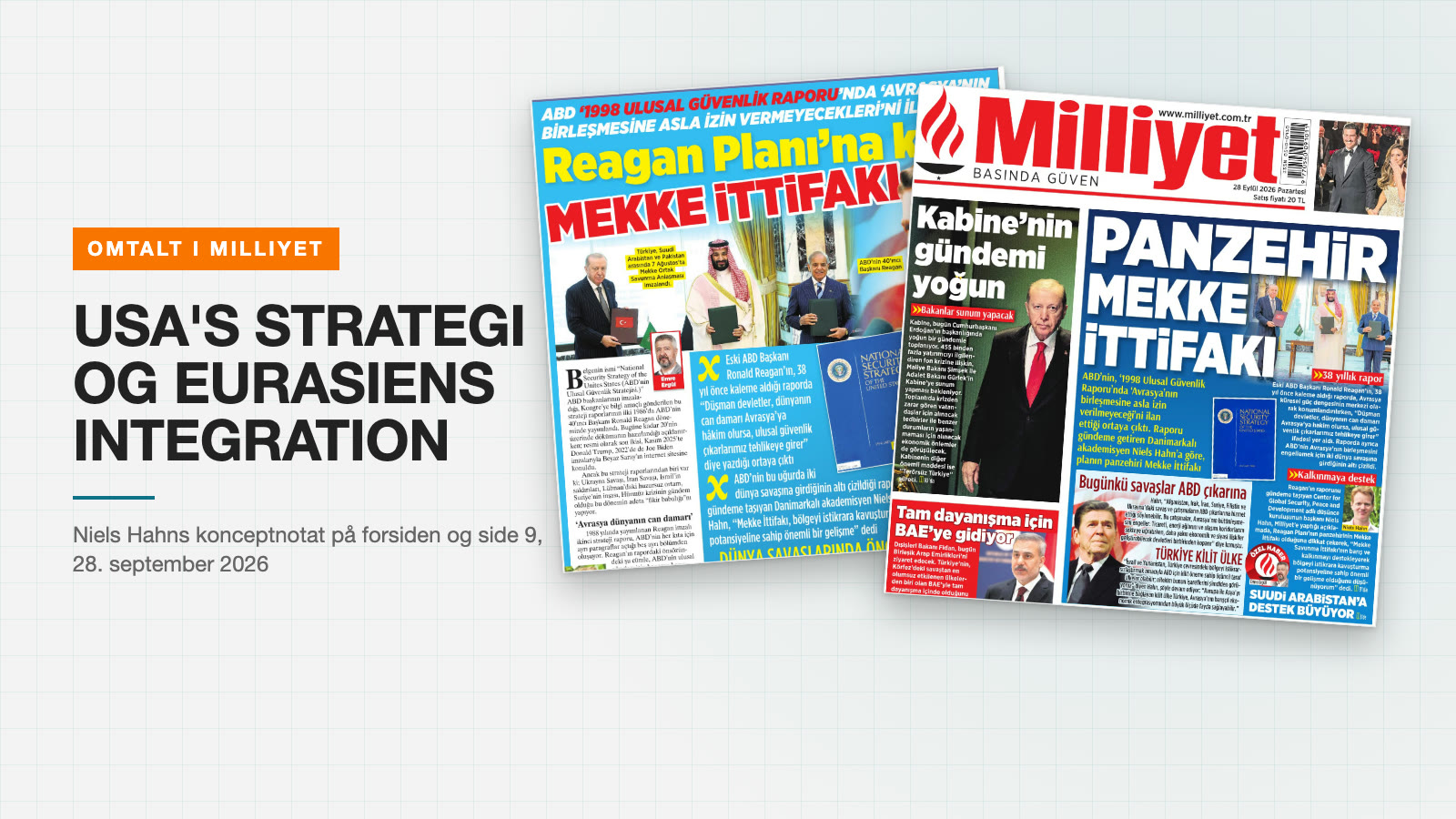
Den tyrkiske avis Milliyet bragte den 28. september 2026 notatet som forsidehistorie og hovedartikel på side 9, med udtalelser fra Niels Hahn om forbindelsen til Mekka-aftalen. Artiklen kan også læses på milliyet.com.tr (på tyrkisk). Notatet er desuden blevet brugt af græske medier.
Notatet er skrevet på engelsk og gengives nedenfor. Det kan også hentes som pdf. Synspunkterne er forfatterens egne.
The US Grand Strategy of Preventing Integration of Eurasia
From Ukraine and the Caucasus to West Asia, Central Asia, Africa and the wider Indo-Pacific, large parts of the world are marked by war, political confrontation and growing militarization. These conflicts are normally explained separately: Ukraine through the confrontation with Russia, West Asia through regional rivalries, Afghanistan through terrorism, conflicts in Africa through internal political instability and competition over resources, and tensions in East Asia through the rise of China.
However, from the perspective of US grand strategy, these conflicts follow a different geopolitical logic. The starting point for understanding this logic is not the official explanation given for each individual war or intervention, but the more fundamental and long-standing US national interest in preventing the integration of Europe and Asia.
This US interest was stated with unusual clarity in the second US National Security Strategy, published in 1988. Written during the final years of the Cold War, the document identified what it called one of the United States’ “most basic national security interests”. More specifically, the first page of the strategy states:
“The first historical dimension of our strategy is relatively simple, clear-cut, and immensely sensible. It is the conviction that the United States’ most basic national security interests would be endangered if a hostile state or group of states were to dominate the Eurasian landmass—that area of the globe often referred to as the world’s heartland. We fought two world wars to prevent this from occurring. And, since 1945, we have sought to prevent the Soviet Union from capitalizing on its geostrategic advantage to dominate its neighbors in Western Europe, Asia, and the Middle East, and thereby fundamentally alter the global balance of power to our disadvantage.”
This passage deserves careful attention because it describes something much larger than the Cold War, something highly relevant to the contemporary wars and conflicts in Europe, Asia and Africa.
The reference to the “world’s heartland” draws on the geopolitical thinking of British geographer Halford Mackinder, who around 1900 identified Eurasia as the center of global land power and argued that its growing integration through railways could weaken the advantages of the great sea powers. Mackinder served the British Empire, and his central concern was a connected Eurasian continent in which Britain, as a major maritime power, would lose influence.
Today, Europe and Asia together contain around two-thirds of the world’s population and an enormous concentration of its industrial capacity, technology, energy, raw materials and military power. If the major economic and political centers of Europe and Asia were gradually integrated into a coherent Eurasian system, the center of gravity of the world economy would increasingly shift towards Eurasia.
Over time, such a development could fundamentally alter the position of the United States. The United States would remain a major country, but it could lose its exceptional domination at the center of the international system. Its ability to influence political and economic developments across Eurasia would diminish, and the economic foundations of its global military power could eventually weaken.
An important aspect of the 1988 strategy is that it explicitly presents this national interest as predating the Cold War. The document refers to American involvement in two world wars as part of the same historical objective of preventing the domination of Eurasia. The geopolitical principle is therefore presented as broader than the confrontation with the Soviet Union. The Soviet Union represented one particular challenge within a much longer geopolitical issue, relevant for understanding history both before and after the Cold War.
The timing of the document is also significant. It was written during the final years of the Cold War, when American policymakers were increasingly considering what the international order might look like after the disintegration of the Soviet Union. The disappearance of the Soviet Union would remove the principal Cold War adversary, but it would not remove the underlying geopolitical question of how power was distributed across Eurasia.
Since the end of the Cold War, it has remained a central issue in US national security debates. In more diplomatic terms, US national strategy is often described as preventing the emergence of regional hegemons in Eurasia, as reflected in a number of recent US Congressional Research Service reports (December 12, 2024, and December 8, 2025).
To summarize the essence of official reports and the literature, the strategy is today essentially about preventing the integration of Europe and Asia, as rising European and Asian economies pose a major challenge to US industries and technologies.
Integration of Eurasia means infrastructure and connectivity. Infrastructure includes extensive road networks, railways, seaports, airports, energy pipelines and electricity grids across the European and Asian landmass. Connectivity extends beyond physical infrastructure to communication systems, financial services, education, health services, technological cooperation, IT systems, the green transition and, increasingly, artificial-intelligence systems. Together, these forms of infrastructure and connectivity can gradually bind the economies of Europe and Asia into a more integrated Eurasian economic space.
One way, among many, in which the United States can impede such integration is through controlled destabilization, particularly in strategically important borderlands and peripheral regions where central governments exercise limited control. Counterterrorism operations in such areas can also create long-term dependencies on US military, security and intelligence cooperation. Such security dependencies provide the US with influence over regional policymakers and security structures.
From this perspective, wars and conflicts in Afghanistan, Iraq, Iran, Syria, Palestine and Ukraine can be understood as serving US interests in multiple ways. Above all, the conflicts prevent the integration of Eurasia. They disrupt infrastructure, trade, investment, energy networks and transportation corridors, while dividing states that might otherwise develop closer economic and political relationships.
For example, the US war in Afghanistan can be interpreted very differently from its officially stated objectives of eradicating terrorism and constructing a stable state. Instead, it can be seen as a strategy of preventing the emergence of a strong central government capable of exercising effective control over the entire country, especially the provinces in the borderlands. A persistently weak and fragmented Afghanistan is less capable of functioning as a stable corridor connecting the surrounding regions. This is geopolitically significant because Afghanistan is situated at a strategically important crossroads in the heart of Asia, linking or bordering Central Asia, China, Pakistan and Iran, and potentially connecting the wider economies of Central, East and South Asia.
Iran can similarly be viewed not simply as an isolated case but as part of the larger geopolitical struggle over the future organization of Eurasia. Iran occupies a crucial geographical position between the Persian Gulf, Central Asia, the Caucasus, South Asia and the Middle East, making it important to trans-Eurasian transport, trade and energy networks. Recent US attacks on Iran have directly targeted such infrastructure.
This perspective is also relevant as Gulf states and other regional powers seek to diversify their international relationships beyond the US and deepen their economic connections with China and the wider Eurasian economy through the Belt and Road Initiative, BRICS and other emerging Eurasian structures. US wars in the region are not only about control over individual countries, but also about the wider pattern of economic and political relationships connecting different parts of Eurasia.
Türkiye is particularly important in this context. It is one of the key countries physically connecting Europe and Asia and could benefit immensely from the peaceful economic integration of Eurasia. Its geographical position gives it the potential to become a major hub for transportation, energy, trade, industry and communications between the two continents. But the same geography that creates these opportunities also creates geopolitical challenges. When the basic US national security strategy is understood as preventing the integration of Eurasia, countries such as Türkiye that connect Europe and Asia become exceptionally strategically important.
From this perspective, the growing tensions between Türkiye and Israel serve the broader logic of US grand strategy, regardless of their immediate causes. The war in Palestine deepens political divisions across West Asia, while Syria has become an increasingly important arena of competing Turkish and Israeli interests. A confrontation between two of the region’s strongest military powers would further fragment the very geographical space through which Europe, Asia and Africa can become more closely connected.
For Türkiye, Eurasian integration represents an enormous economic and strategic opportunity. Realizing this potential, however, requires a clear understanding of the larger geopolitical forces that can promote or obstruct Eurasian integration. Such knowledge and awareness are crucial for sound policymaking, not only for protecting Türkiye’s long-term national interests, but also for the region.
More broadly, understanding US grand strategy and the different ways in which it is implemented across the Eurasian landmass is fundamental to developing policies that reduce conflict and strengthen regional cooperation. Greater awareness of these geopolitical structures can help Eurasian countries pursue their own long-term interests and create the conditions for peaceful integration, economic development and greater regional stability.
Kilder
- The White House (1988): National Security Strategy of the United States, januar 1988. history.defense.gov
- Congressional Research Service: Defense Primer: Geography, Strategy, and U.S. Force Design (IF10485), versionerne af 12. december 2024 og 8. december 2025. Seneste version på congress.gov.
- Milliyet, 28. september 2026: »Reagan Planı’na karşı Mekke İttifakı«. milliyet.com.tr (på tyrkisk)
- Center for Global Security, Peace and Development, som Niels Hahn er direktør for: cgspd.eu
Links til kilderne er tilføjet af RIKO.